
Most stamped patios run about $10 to $20 a square foot installed, which on a normal-size patio lands most projects somewhere between a few thousand dollars and the low five figures. The spread is that wide because “stamped patio” covers a plain one-color square and a multi-color, multi-pattern job with steps and a seat wall, and those are not the same project. Your number comes down to size, the pattern and colors you pick, how much the site needs graded and prepped, and any extras you add. We will not quote a patio off a photo. We come measure, look at your grade and your drainage, and give you a firm price. Here is what moves the number, and why the cheapest bid is rarely the cheapest patio ten years on.
Key takeaways
- Most stamped patios run about $10 to $20 per square foot installed, with pattern and color complexity driving most of the spread.
- Size, site prep and grading, and extras like steps, seat walls, or a firepit pad move the number as much as the stamping itself.
- What you cannot see is what makes it last: a compacted base, the right thickness, reinforcement, and properly cut control joints.
- A firm price comes from an on-site measure, not a photo. We look at your grade and drainage first.
- Book early. The good pour windows fill up fast, and the cheapest bid is rarely the cheapest patio over ten years.
How much does a stamped concrete patio cost?
The short answer is the range up top: about $10 to $20 a square foot installed for most jobs (Concrete Network, 2026). A small, single-color patio with one clean pattern sits at the low end. A larger patio with a contrasting border, two-tone color, and a more involved pattern climbs toward the top, and a fully detailed design with steps and a seat wall can pass it.
That spread is wide on purpose, because “stamped patio” covers a lot of ground. The trade publishes those national averages and they hold up fine as a starting point here. What they cannot tell you is your number, because they have not seen your yard. So treat the range as your ballpark and let us measure for the real figure.
Why do two same-size patios cost different amounts?
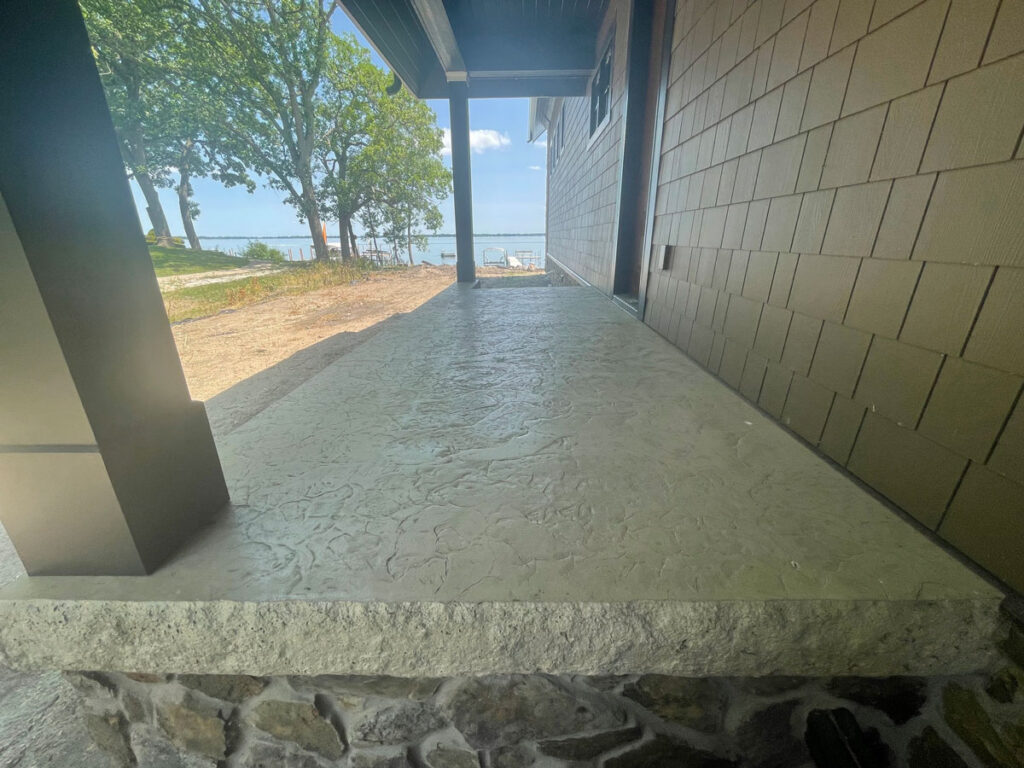
Because square footage is only where the estimate starts. It is the biggest single number, no question, and here is a wrinkle most people do not expect: bigger patios usually cost a little less per foot. Mobilizing the crew and forming the job costs about the same whether we pour 200 square feet or 600, so spread over more area, the per-foot price drops.
The design is where stamped concrete earns its name and most of its spread. One pattern, one color, clean rectangle: that is the affordable end. Add a contrasting border, a second color, hand-troweled accents, a tighter stone or slate stamp, and you are buying labor, because every one of those is hand work on a clock. It is worth it to a lot of folks. It is also the easiest place on the whole job to spend more, so walk in knowing that.
Then there is everything that happens before the truck shows up. Tearing out an old patio is demo. Grading the ground so water runs away from the house instead of ponding on your new slab is prep, and we run laser surveying to get that grade dead-on, because fixing drainage after the fact costs far more than getting it right the first time. Steps, a seat wall, a firepit pad, curves: each one nudges the number up. Those are usually the parts you actually use, so they tend to earn their keep, but they are extras and they belong in the conversation up front, not as a surprise on the invoice.
Is stamped worth it over a plain or paver patio?
Depends what you want. A plain broom-finish slab is the budget option and there is nothing wrong with it. It is durable and it does the job. Stamped costs more because of the labor in the pattern and color, but it gives you the look of stone or brick in one continuous, sealed surface with no joints for weeds to come up through.
Pavers are the other common comparison. They look great and individual pieces can be lifted and reset, but the labor is high and the joints need sand and the occasional weed pull. Stamped concrete sits in between on a lot of jobs: more finished than a broom slab, fewer maintenance headaches than pavers. None of the three is the “right” answer for everybody. We will give you the straight version for your yard and budget rather than steer you to whatever has the biggest margin.
Will it hold up to Iowa freeze-thaw?
It will, if it is built right, and “built right” is mostly the stuff you cannot see in the finished photo. We get dozens of freeze and thaw cycles a winter up here. Water works into the surface, freezes, expands, and pries the concrete apart from the inside. That is what scales and cracks a slab that was poured cheap.
The defense starts in the mix. Exterior flatwork that faces freeze-thaw should be air-entrained, meaning microscopic air bubbles are built into the concrete to give that expanding ice somewhere to go instead of into your slab. The industry standard for flatwork is around 6% entrained air, but on decorative stamped work it is often dialed closer to 4%, because too much entrained air cuts the bleed water the color hardener needs to take properly (Concrete Network, 2026). Hitting that balance, durable but still able to hold color, is the kind of thing a crew that pours decorative concrete every week gets right and a low bidder often does not.
The rest is underneath and around it: a properly compacted granular base, a slab poured to the right thickness, reinforcement, and control joints cut where they belong. Concrete is going to move. Joints decide where it cracks. Skip them or space them wrong and the slab picks for itself, usually a line running off an inside corner where the stress piles up. We see that exact failure on cheap pours all the time, a crack snaking off the corner of a step or a planter where nobody bothered to put a joint.
Then it gets sealed, and the seal keeps water and de-icer out of the surface. Reseal every few years. Easy test: when water stops beading on top, it is time. Sealed on schedule, a stamped patio looks sharp for decades. Poured cheap on a thin base, it tells on itself by the second or third spring. This is my dad’s line, the one I cannot shake: do not be the cheapest. The lowest bid usually shows up in the spring you find the cracks.
When should you schedule the pour?
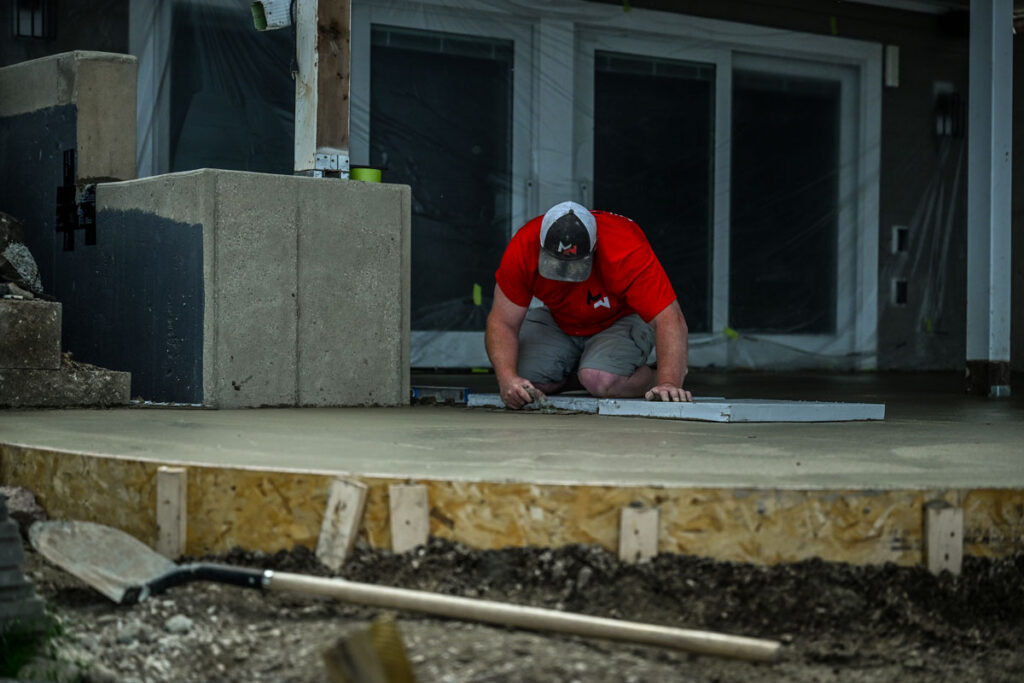
Earlier than you think. Spring through fall is the window, and the calendar fills as soon as the weather turns. If you want a patio to enjoy this summer, the time to get on the schedule is before the season is in full swing, not the week you decide you want it.
That is also the honest reason to call now rather than later: not pressure, just the reality of a short building season in northwest Iowa and a crew that books up. Get measured early, lock your spot, and your patio is done while there is still summer left to use it.
This is the kind of project where one local crew that does it every week is worth more than the cheapest number. At Midwest Concrete & Excavating, our guys handle the whole job, demo, grading with laser surveying, the pour, the stamping and color, and the steps and walls, and we are fully insured and local. If your patio ties into a retaining wall, a firepit, or shoreline work, the Midwest Landscape & Design crew is the same family of companies, so it is one call instead of five. We will not quote you off a photo. Schedule a call and we will come measure, look at your grade and drainage, and give you a firm price for your yard.
FAQ
How much does a stamped concrete patio cost per square foot?
Most stamped patios run about $10 to $20 per square foot installed, with simple single-color work at the low end and multi-color, multi-pattern designs at the high end (Concrete Network, 2026). Your exact number depends on size, design, site prep, and any steps or walls. We give a firm price after an on-site measure.
Is stamped concrete cheaper than pavers?
Usually, yes, mostly because pavers carry high labor and ongoing joint maintenance. Stamped concrete gives you a decorative look in one continuous sealed surface. Pavers have their own advantages, like being able to lift and reset individual pieces, so the right choice depends on your priorities and budget.
How long does a stamped concrete patio last?
Built right and resealed every few years, a stamped patio lasts for decades. Longevity comes from the work you cannot see: a compacted base, correct thickness, reinforcement, and properly cut control joints. A patio poured cheap on poor prep is the one that cracks early in Iowa’s freeze-thaw cycles.
How often do I need to reseal it?
Plan on every few years. The simple test is whether water still beads on the surface. When it stops beading, it is time to reseal to keep moisture and de-icer out of the concrete.
Can you match a stamped patio to my house or existing concrete?
In most cases, yes. There are a lot of pattern and color options, and we will walk through them with you so the patio fits your home and the rest of your hardscape. Bring photos of what you like to the conversation.
A patio is one of those projects you look at every single day, so it is worth getting right the first time. If you are weighing it for this summer, do not wait on the schedule. Schedule a call with Midwest Concrete & Excavating and we will come measure, talk through patterns and grading, and give you a firm, honest number.