
A boat hoist in the Iowa Great Lakes costs less than most people expect for a personal watercraft and more for a big pontoon or deck boat, because the price tracks the weight you are lifting and the options you bolt on. The number comes down to your boat’s loaded weight, the lift style (an aluminum vertical lift or a steel cantilever), whether you add a canopy and side curtains, and whether you need a new dock to go with it. We publish starting prices for ShoreStation boat lifts, pontoon lifts, and PWC lifts so you are not guessing, but the firm number always comes from a quick look at your boat and your shoreline. Here is what moves the price, and how to size a hoist so you only buy it once.
Key takeaways
- A hoist’s price tracks the weight it lifts, so a PWC lift sits at the bottom and a big pontoon or deck boat lift at the top.
- Size by your boat’s dry weight plus fuel, gear, and passengers, then leave room. An undersized hoist is the most expensive mistake you can make.
- Aluminum vertical lifts and steel cantilever lifts both work well. The right one depends on your boat, your dock, and your water depth.
- Published ShoreStation pricing gives you a real starting point. A firm number needs us to see your boat and your shoreline.
- Every dock and hoist on public water needs an Iowa DNR permit, and the fee has to be paid before a boat goes in the lift.
How much does a boat hoist cost?
Most people call us wanting one number, and we get it. Nobody likes a contractor who dodges the price question. The trouble is that “a boat hoist” covers everything from a single PWC lift you could move by hand to a 15,000 pound steel hoist holding a loaded pontoon, and those are not the same purchase.
So we did the thing most lake outfits will not do: we put starting prices right on the site. You can see real numbers for ShoreStation free-standing lifts broken out by boat, pontoon, and PWC, before you ever pick up the phone. Use those as your anchor. Then know that the figure on your invoice depends on a handful of things we will walk through below, and the only way to lock it in is to let one of our guys look at your boat and your shoreline. We do not quote a hoist off a photo, because the wrong size helps nobody.
What actually drives the price?
Weight, mostly. A hoist is rated for a load, and a heavier boat needs a heavier-rated lift built stouter, so the gap between a jet ski lift and a lift for a loaded 24 foot pontoon is real money. That one factor moves the number more than all the rest put together. Buy for the boat you have, and do not cut the rating close.
After that it is the choices you make. An aluminum vertical lift and a steel cantilever lift get to the same place by different routes and price differently, and we will get to which is which in a minute. A canopy to keep the sun and the bird mess off your boat is worth every penny up here, but it is an add-on, and so are side curtains. Neither is required. Both are nice to have.
Then there is your shoreline. We set every hoist by barge, and a clean, deep frontage is a quick job. Shallow water, a rocky bottom, a long reach out to depth, an awkward angle off the dock: that takes more time and more equipment, and it shows up on the estimate. None of it stumps our crew. It just costs what it costs.
How do I size a hoist for my boat?
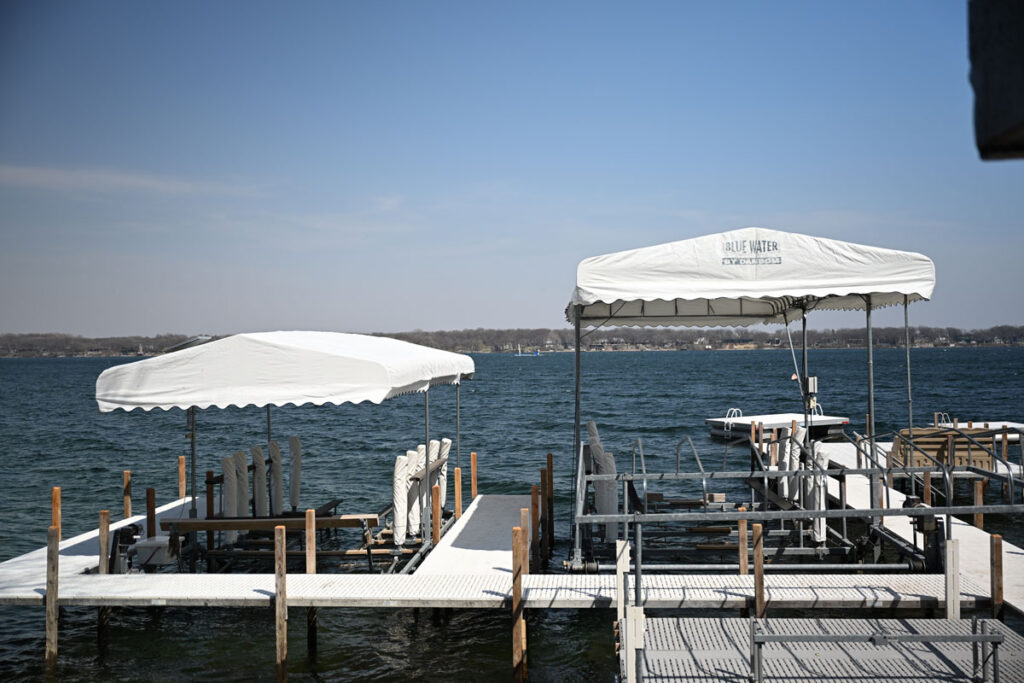
Here is the part people get wrong. Do not size off the dry weight stamped on the brochure. Start with that dry weight, then add fuel, the battery, gear, coolers, and the people who actually ride with you. A full tank and a loaded cooler add up faster than you think, and on a hot Saturday you are lifting all of it.
Add that real loaded weight up, then pick a hoist rated comfortably above it. The extra capacity is cheap insurance. An undersized hoist strains, wears out early, and can let you down on the worst possible day, which makes it the most expensive lift you can buy. When in doubt, we would rather you go one size up. Our service manager Cory has pulled more than a few motors back to life over the years, and the common thread on the ones that fail early is a lift that was asked to do more than it was built for.
You can see it every fall when we pull lifts. The ones that come out tired, bent cradles, frayed cables, a motor on its last legs, are almost always the lifts that got sized a hair too light and then carried a full boat all summer. Size it right once and you mostly stop thinking about it.
Aluminum or steel: which lift is right?
We sell both, and we are happy to put you on either one, so this is an honest comparison rather than a sales pitch for whichever we have in stock.
ShoreStation hoists are aluminum frame vertical lifts. They run smooth, they are light to handle, and aluminum does not rust. DuraLift hoists are steel frame cantilever lifts, built heavy and strong, and they are the workhorse end of the range up to that 15,000 pound rating. Both can take optional side curtains.
One real difference worth planning around is the canopy timing. On a steel hoist, we can put the canopy on as soon as the hoist is in place. On an aluminum hoist, the canopy goes on after your boat is in the water. It does not change which is “better,” but it changes the order of operations on install day, and it is the kind of detail that is easy to miss until you are standing on the dock wondering where your shade is.
What does a dock add to the cost?
A hoist usually does not live alone. If you need a dock too, that is its own line on the estimate, and it ranges as widely as hoists do depending on length, layout, and the system you choose.
We carry ShoreStation aluminum docks in free-standing and 4×4 post configurations, used inventory when we have it, and our own Dominator dock system, which is exclusive to us. The Dominator is extruded aluminum with flow-through decking that lets wind and water pass through instead of fighting it, which matters on a windy stretch of Lost Island or Big Spirit. It carries a 15 year structural and hardware warranty and a lifetime limited warranty on the decking, and it is backed by our High Wind and Water Guarantee. Those are the actual terms, not a round number we made up, and they are part of what you are paying for.
Do I need a permit for my dock and hoist?
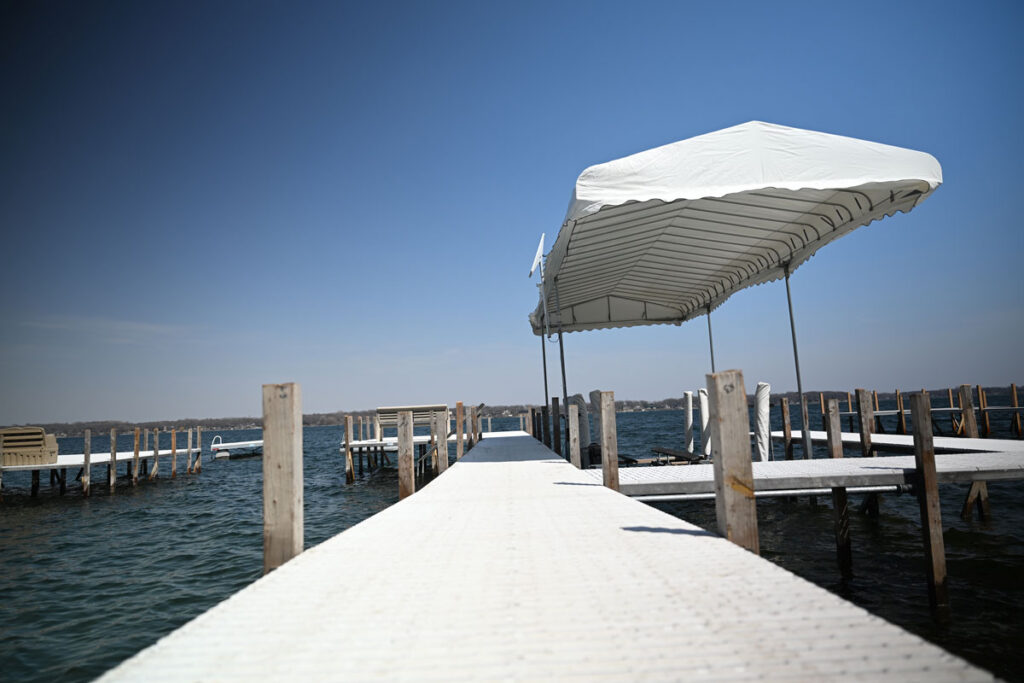
Yes, and this is not a corner to cut. Every dock, hoist, buoy, and platform on Iowa public water has to be permitted and signed through the Iowa Department of Natural Resources, and any fees owed have to be paid in full before the dock goes in and before a boat is placed in the hoist. You can read the rules straight from the source on the Iowa DNR dock permits page, which is governed by Chapter 16 of the state administrative rules.
The classes, offsets, and dock management area rules get detailed, and they do change, so if you are unsure where your setup lands, ask us or ask the DNR rather than guessing. We deal with this every season and can point you the right way. It is not a big cost, but it is a real step, and it is the kind of thing that is a headache if it gets skipped.
This is where having one crew for the whole job earns its keep. At Midwest Lake Service, the same team sets your hoist, installs your dock, handles shoreline work, and runs on-water fuel out to you during the season, all by barge. Once you are on our service list, we schedule your dock and hoist in and out automatically every year unless we hear otherwise, so you are not chasing five different vendors every spring. My sister Mandy runs the lake side and our guys do this week in and week out from the spring launch through the fall pull. If you want the real number for your setup, the fastest way there is to start with our published ShoreStation pricing and then schedule a call so we can size it right.
FAQ
How much does a boat hoist cost in the Iowa Great Lakes?
It depends mostly on the weight of your boat and the options you add, which is why we publish starting prices for ShoreStation boat, pontoon, and PWC lifts rather than quote a single figure. A PWC lift sits at the low end and a large pontoon or deck boat lift at the high end. For a firm number, we measure your boat and look at your shoreline.
What size hoist do I need?
Take your boat’s dry weight and add fuel, the battery, gear, and passengers to get the real loaded weight, then choose a hoist rated comfortably above it. Going one size up is cheap insurance against early wear. If you are not sure, we will run the numbers with you.
What is the difference between a DuraLift and a ShoreStation hoist?
DuraLift hoists are steel frame cantilever lifts, built heavy for strength up to 15,000 pounds. ShoreStation hoists are aluminum frame vertical lifts that run smooth and will not rust. Both can take optional side curtains, and both are solid choices depending on your boat and dock.
Do you handle the dock permit?
Every dock and hoist on public water needs an Iowa DNR permit, and the fee has to be paid before installation. We deal with the process every season and can point you in the right direction, but the permit itself is issued through the DNR. When in doubt on your situation, check the Iowa DNR dock permits page or ask us.
Do I have to call every year to get my dock put in?
No. Once you are on our service list, we schedule your seasonal dock and hoist install and removal automatically unless you tell us otherwise. That is one less thing for you to track each spring and fall.
The lake season is short up here, and the worst time to figure out your hoist is the week everybody else is trying to get on the water. If you are buying, upgrading, or just want to know what your setup runs, start with our ShoreStation pricing pages for a real starting point, then schedule a call and we will size it right and give you a firm number.